
STARS - HR Diagrams
OPENING QUESTIONS: A coupla your friends feel a VERY strong attraction to each other. Although it may be a strong force, it isn't THE strong force.
Why not?
Oh Be A Fine Goat, Kick Me -- Pop Quiz!

OBJECTIVE: Formative review of life cycle of stars
WORD FOR TODAY:
- solar nebula
- fusion
- nucleosynthesis
- Strong Force
- main sequence
OBSERVATION: Not Tonight
WORK O' THE DAY:
Shall we sing? YES!!! It's time for the SUN SONG!
═══════════════════════════
If time permits!
Take a gander at this image.... take a few moments to copy this into your notes and have a conversation with your group to suggest an explanation for what's going on here:

Here's a more detailed look:
4 protons are MASHED together in the intense temperature (MILLIONS OF DEGREES) at the core of a star.
That process is actually quite a bit more complex than displayed above, but the end result is the same.... 4 protons are mashed together resulting in 2 protons and 2 neutrons forming the nucleus of a helium atom PLUS energy.
An interesting part of this is that very, very, tiny, small, little bitty amount of energy is released in this reaction.
So my next question to you all (my MOST gracious & humble astronomy students is: Where does all the MASSIVE amount of radiation put out by the sun come from?
═══════════════════════════
Now let's mush on to today's work:
Please take a look at the H-R Diagrams I've passed out. Work with your groupies to make observations of this chart.
Oh and first of all, let's see if anyone has any questions on the terms found here:
Now please write your observations down on strips (no more than 5 words please!)
Now please categorize your strips... which observations seem to go together? Which stand alone?
Now let's get them on the board...

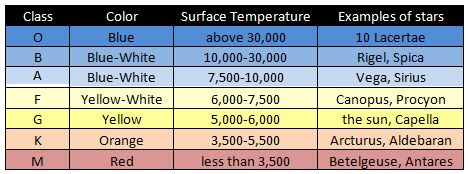
Here are examples of stars I want you to keep in mind:
Red Dwarfs
|
Yellow Stars
|
Blue Giants
|
|
Class: |
M
|
G
|
O
|
Surface Temp: |
3500 K
|
5,000 K
|
>30,000 K
|
Size: |
.5 sun or so
|
Sun Size
|
10 x sun
|
Age: |
Trillions of years!!! |
10 billion yrs |
~50,000 years |
Born: |
Stellar Nebula |
Stellar Nebula |
Stellar Nebula |
Death: |
Whimper |
Drift Away |
Cataclysmic! |
Notice that all of these stars appear as part of the "main sequence". Think of main sequence as being middle age..... the period of time in which stars spend the bulk of their 'life' is called the main sequence.
Recall that ALL stars are born in a solar nebula
ALL Stars live most of their lives as a star on the Main Sequence
ALL Stars die (sometimes very dynamically, other times with a whimper)
Now let's compare HR Diagram stars with our chart of where atoms on the periodic table come from, any insights?